The Teaching Game
Playing with education in Second Life
Seeing beyond the hype
In the end the debate around Second Life, and how like a game it is, may well be superceded by events. The increasing use of SL by many physical world commercial enterprises for serious business ends coupled with the growing recognition of the validity of digital games as serious learning environments [23] could lead to the disarming of arguments against the funding of the educational use of games and Second Life in particular. Certainly SL has achieved a level of coverage in the mass media that far surpasses all other MMORPGs. It is likely rather, that its efficacy, for any number of applications, will be judged by what it is seen being used for under the glare of the media’s spotlight. In this context the immediate problem may well be overcoming public perceptions of Second Life as a haven for pornography and gambling much in the way the web used to be viewed.
It also remains to be seen how Second Life will survive the “Technology
Hype Cycle” [24] that, Gartner technology analysts
predict, is the course that all new technologies must traverse before
they achieve ubiquitous utility. Using the terminology of the hype
cycle [25] it’s easy to speculate that Second
Life is at or near its “peak of inflated expectations” with the
inevitable “trough of disillusionment” lying ahead. If
Second Life or a similar virtual world establishes its value then we can
look forward to the “slope of enlightenment” and the final “plateau
of productivity”.
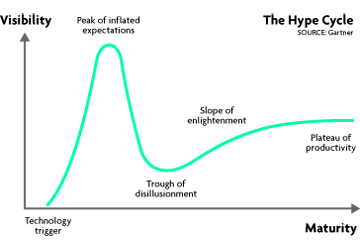
It does not take a great leap of the imagination to see a parallel course being taken by the educational uses of Second Life - perhaps a little behind the hype but charting a very similar trajectory.
[23] Van Eck, R., (2006). Digital Game Based Learning: It’s Not Just the Digital Natives Who Are Restless, Educause Review, vol. 41, no. 2 (March/April 2006): pp. 16-30
[24] Understanding Hype
Cycles.
Retrieved: 21 December 2006.
[25] Twist, J., (30 August 2004). Peering beyond the technology hype.
News.bbc.co.uk
Retrieved: 21 December 2006.
A copy of this document as a Word format file is available here.