The Teaching Game
Playing with education in Second Life
A virtual society
Second Life therefore has much in common with online games but debate around its game status persists. Linden Lab do not promote Second Life as a game, it is instead, “a virtual society complete with its own economy and social structure” [7]. The fact that there are few rules to follow in SL, that all content is user generated and that there are no system dictated overarching goals for subscribers to achieve are frequently cited as reasons why SL is not a game. Additionally subscribers or registered users of SL are officially described as “residents” not players.
A blank canvas
Cory Ondrejka [8], Linden Lab Chief Technology Officer, explains that the emphasis on content creation by users was a deliberate policy to overcome the development and maintenance overhead of an online game. “residents of online worlds consume content at an incredible rate.” Consequently motivation and context are crucial to providing the impetus for this creative activity and this was a key factor in the decision to situate Second Life in an earth-like environment.
So while it may be uncontroversial to state that Second Life sits somewhere between a game and something else, the degree to which it can be categorized as a game is still a bone of contention.
[7] Sulic, I., (8 April 2006). IGN: Second Life
Preview.
Retrieved: 29 December 2006.
[8] Ondrejka, C. R., (7 June 2004). A Piece of Place: Modeling the Digital on the Real in Second Life. Social Science Research Network.
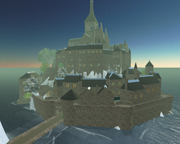
Shivar
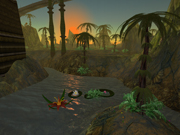
Svarga
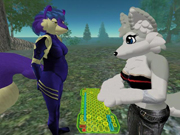
Furry avatars
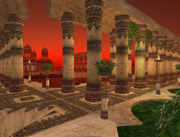
The Lost Gardens of Apollo