The Teaching Game
Playing with education in Second Life
Playing the teacher
But notions of game behaviour also directly impact educators themselves as they set up shop in Second Life. Sherry Turkle, in discussing SL [17], emphasizes the need to have a place for this type of “imaginative play in our lives” - presumably including teachers’ lives as well. Possibly for the first time in their careers, in Second Life educators get to “play” at being teachers without some of the real-life consequences that “playing” might have in a physical classroom, lab or lecture theatre. And of course educators in Second Life have the freedom to set the rules for their appearance in SL in a way that is not possible in a physical institution.
How do I look in this?
The Second Life educator has to decide how a teacher’s avatar should look. What a teacher’s Second Life environment should be like and how a SL teacher should teach. Sarah Robbins in discussion with Jeremy Kemp [18] explains that in designing her avatar’s appearance she set out “to create a professional persona in SL” to form “an extension of her professional self” in the rest of her life. So perhaps decisions about avatar appearance and the teaching context are based on a combination of wish fulfillment and performance.
In a deliberately open-ended virtual world where participants are not directed towards specific roles a wide range of groupings have formed adopting their own self-imposed narrative on their participation in Second Life. Some of these have been imported from fictional texts or even other virtual worlds. Second Life is home to the fantasy role-play of Gor, the translation of the Star Wars universe to rigorously enforced role-play sims together with the more “traditional” online incarnations of furries and vampires.
[17] (28 March 2006). Living in Game Space.
Open Source Radio. MP3 audio file.
Retrieved: 29 December 2006.
[18] Robbins, S., (July 13, 2006). Intellacast:
Episodes 2 and 3. Podcast.
iTunes > Podcasts > Second Life Education Research > Intellacast: Episodes 2 and 3


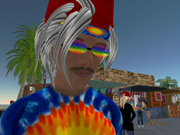
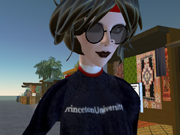
Glasses = teacher in Second Life